Home garage guide
In a home garage the constraints are usually space and headroom, and the equipment has to fold away afterwards.
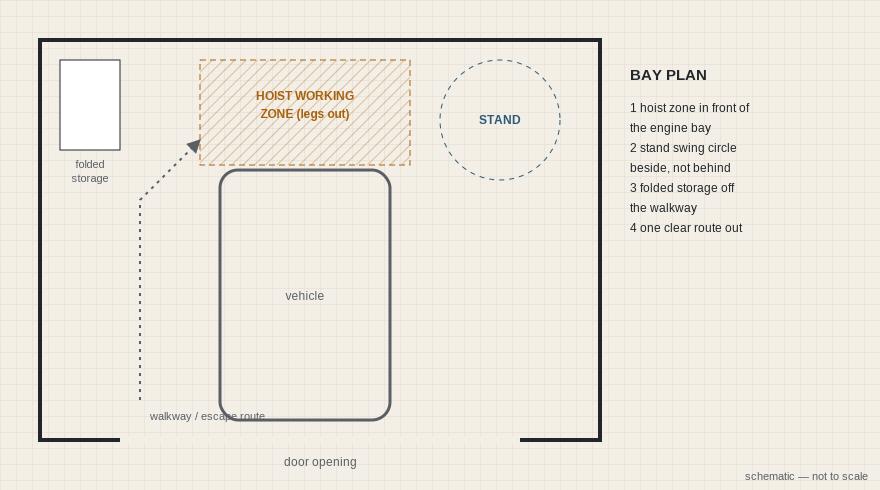
1. Measure before you browse
Measure the bay length in front of the vehicle, the lowest overhead obstruction, and the spot where folded equipment will live. Use the space checklist.
2. Know the load
Find a reliable weight for the engine as it will come out, including anything left attached. Use the intended-load checklist.
3. Choose the hoist on what the listing commits to
For a home garage, favour listings that state per-position boom ratings and something about folded size. Only one hoist listing on this desk states a folded width (Maxsa 2 Ton, 24"). Compare on the 2-ton comparison.
4. Add a leveler that is not the weak link
If you need to tilt the engine to separate or join it to a transmission, add a leveler and check its rating against the path — see matching a leveler.
5. Pick a stand for the work after
If the engine will be worked on, a rotating stand whose capacity covers it is the next purchase. See stand capacities.
6. Read the floor
Home slabs often slope toward the door. Map the route with the floor checklist.
If the job, the space or the floor does not fit the equipment’s manual, the right move is a professional shop, not a workaround.