Matching a load leveler to a hoist
The leveler, chains and brackets each carry a label. The useful question is which of them is lowest, and whether your load sits comfortably under it.
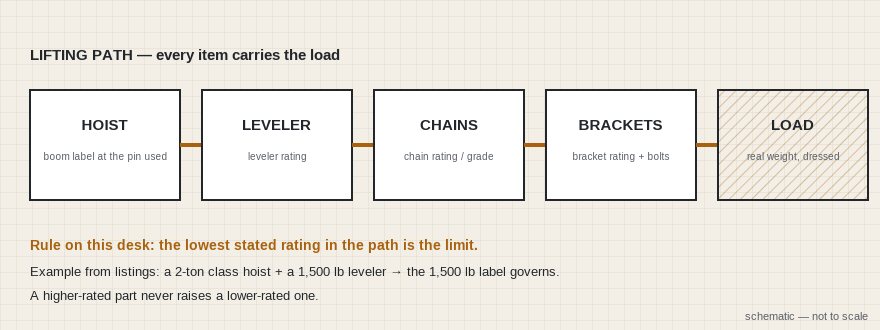
Step by step
- Write down the boom label rating at the pin you will use, from the hoist itself.
- Write down the leveler rating from its label or listing.
- Write down the chain and bracket ratings, including the bolts the bracket instructions call for.
- Circle the lowest figure. That is the limit of the whole path.
- Compare it with a reliable figure for the real load — see the intended-load checklist.
Two worked readings from listings
VEVOR hoist with included leveler. The listing states 4400 lbs/2 tons for the hoist and 1500 lbs/680 kg for the leveler. With that leveler in the path, the 1500 lbs figure governs, before the boom label and chains are even considered.
A 2-ton class hoist with the OTC 1812. The leveler states 6,000 pound. That does not raise the hoist; the boom label at the chosen pin still governs.
Physical fit
Check that the hoist hook seats correctly in the leveler’s hook point, that the leveler’s spread suits the engine’s lifting points, and that the added height of leveler plus chains still clears your ceiling at full lift — see ceiling and reach clearance. Fit is confirmed from manuals, not from a listing photo.