Restoration project guide
Restorations bring two specific problems: weights you cannot look up easily, and an engine that may stay on a stand for a long time.
Unknown weights
Older engines may carry non-original parts, and published weights may not match what is in front of you. Treat any figure as uncertain and choose equipment whose stated rating leaves comfortable margin over your best estimate. If you cannot get a reliable figure, ask a specialist for your engine type before lifting.
Lifting points on old engines
Original lifting eyes may be missing or damaged, and threads may be worn. Lifting brackets bolt to threads; whether a thread is suitable is a question for the engine documentation and a qualified person. See brackets, plates and chains.
Seized or stuck components
A hoist is not designed to pull against something stuck. If an engine or transmission will not come free, lower the load and find out why before lifting again. Do not use the hoist to force it.
Long stand time
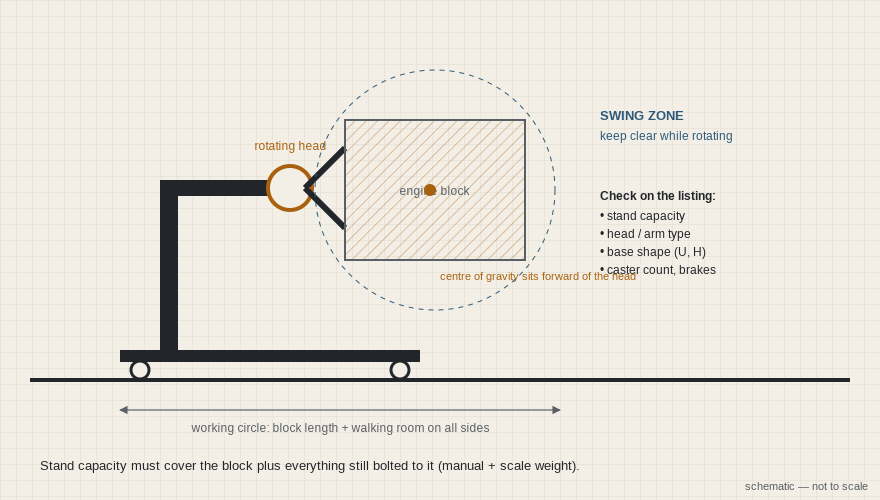
A block may live on a stand for months. Choose a stand whose capacity covers the engine as mounted, store it on a level spot out of the walkway, and check that the head and arm bolts remain as the stand manual specifies. See mounting heads, bases and casters.
Keep records
Keep the manuals, the label readings for each item in the lifting path, and any written seller answers in one folder with the project notes.